

Ask in words
“Show me the cars of the last 24 hours.” The passages appear in the viewer; you look at the images and judge. No query language, no export to a spreadsheet.
Argus watches a set of cameras and turns them into something you can question. It detects a passage, describes it, files it, and keeps the history searchable in plain language. When the call matters, a human confirms or corrects — and the system remembers the correction.
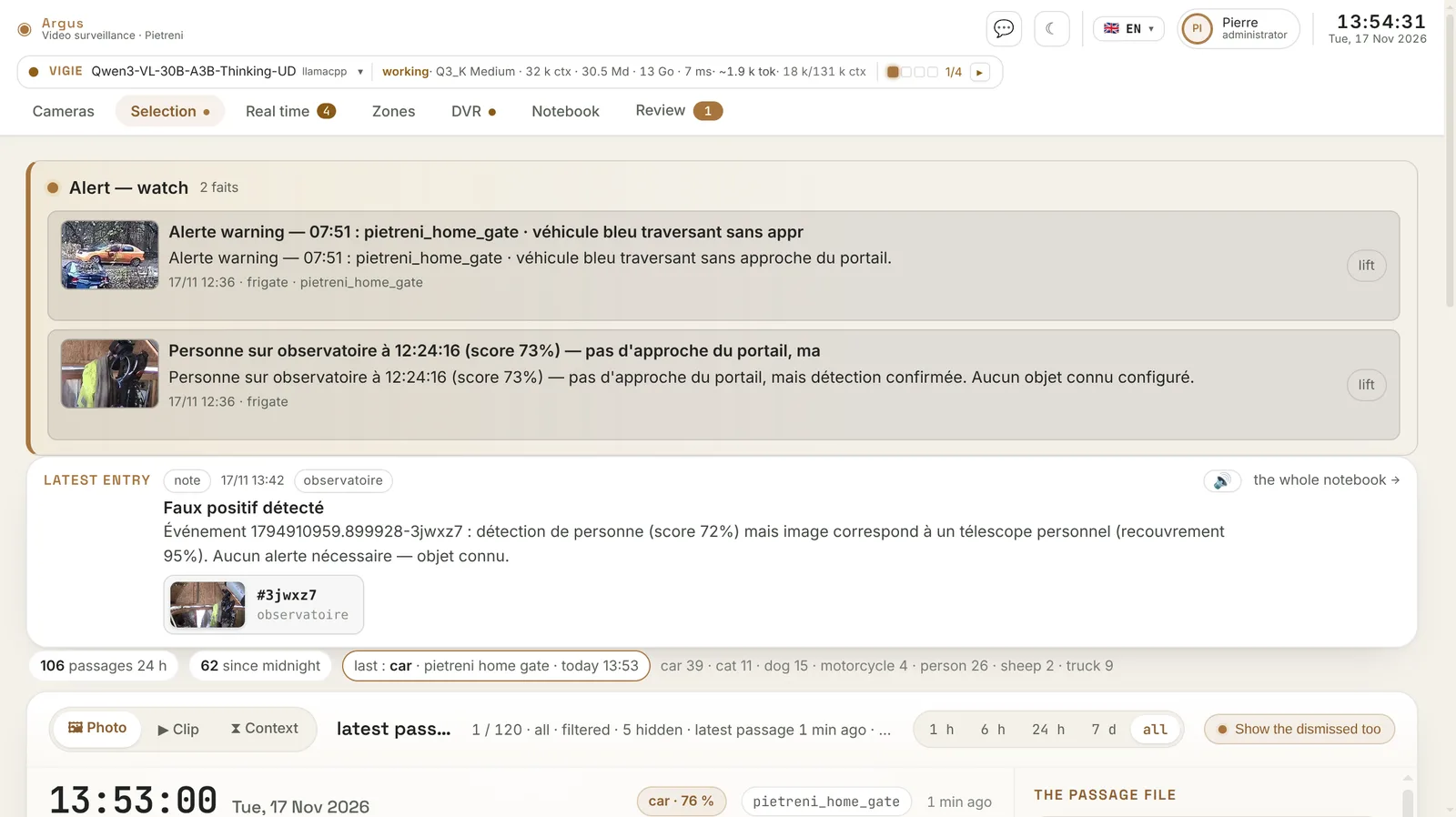
Detection is a component. What makes it a watchman is the layer above — the one that knows your car, dismisses the cat, and writes the night down.
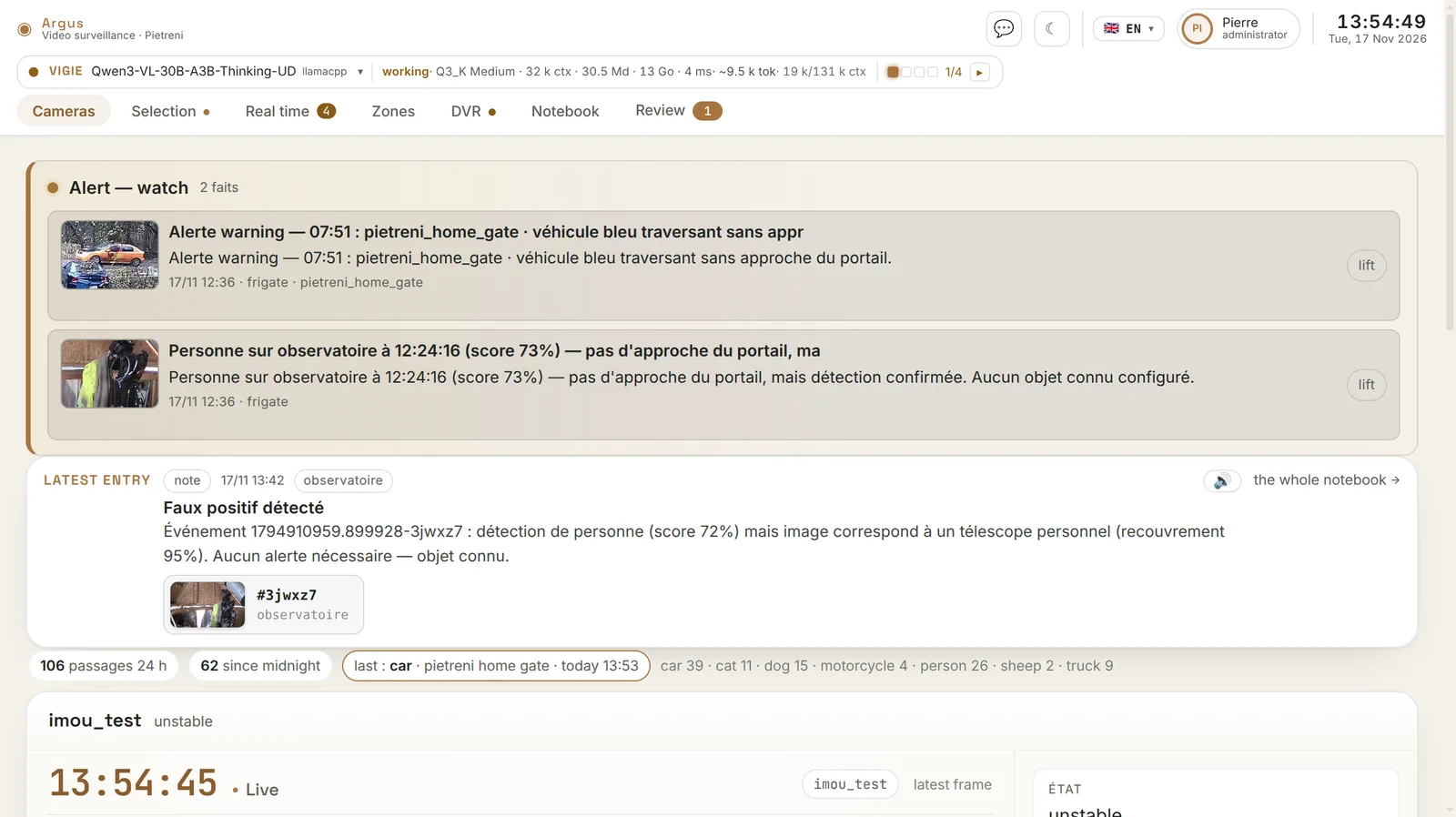
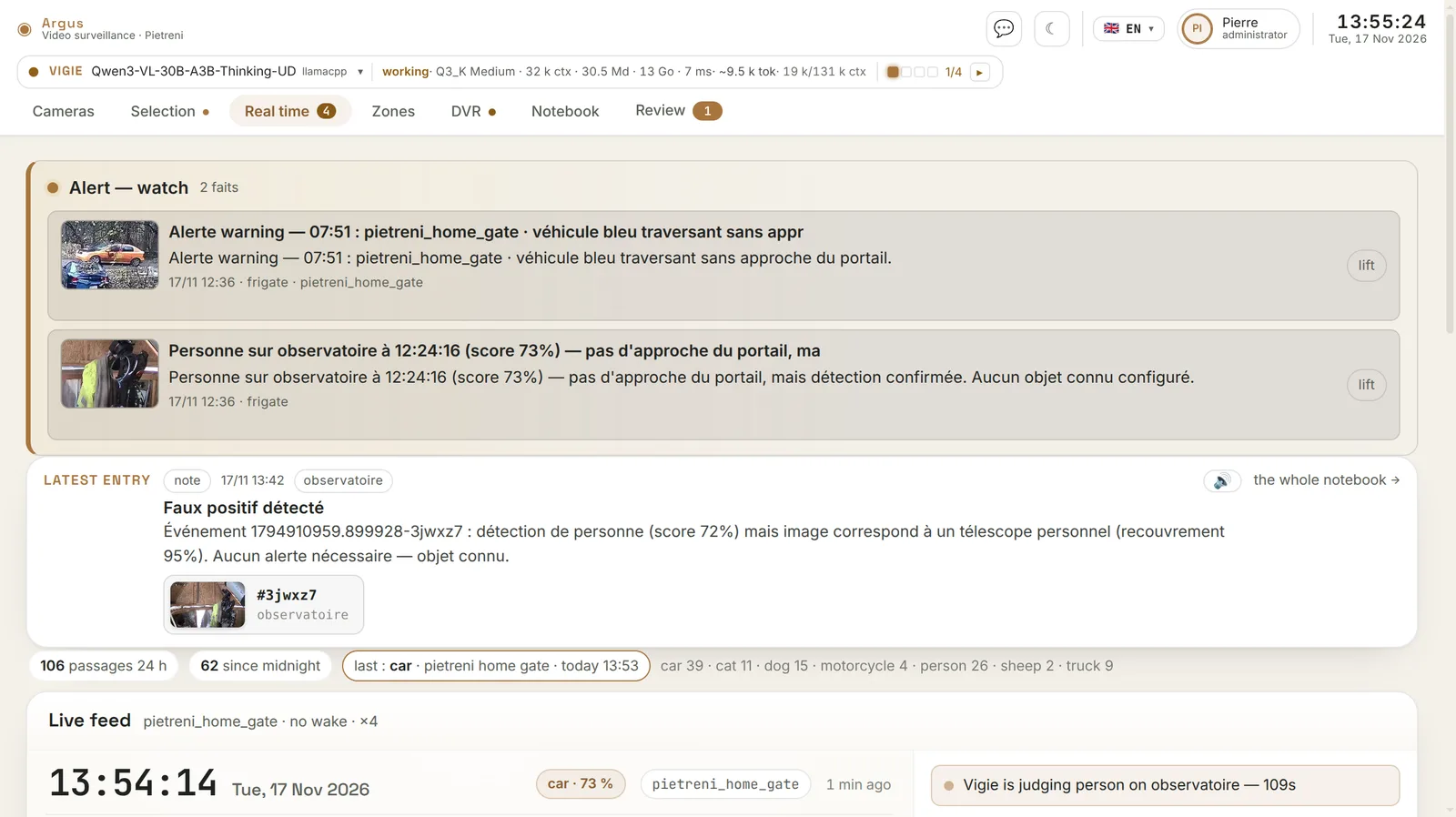
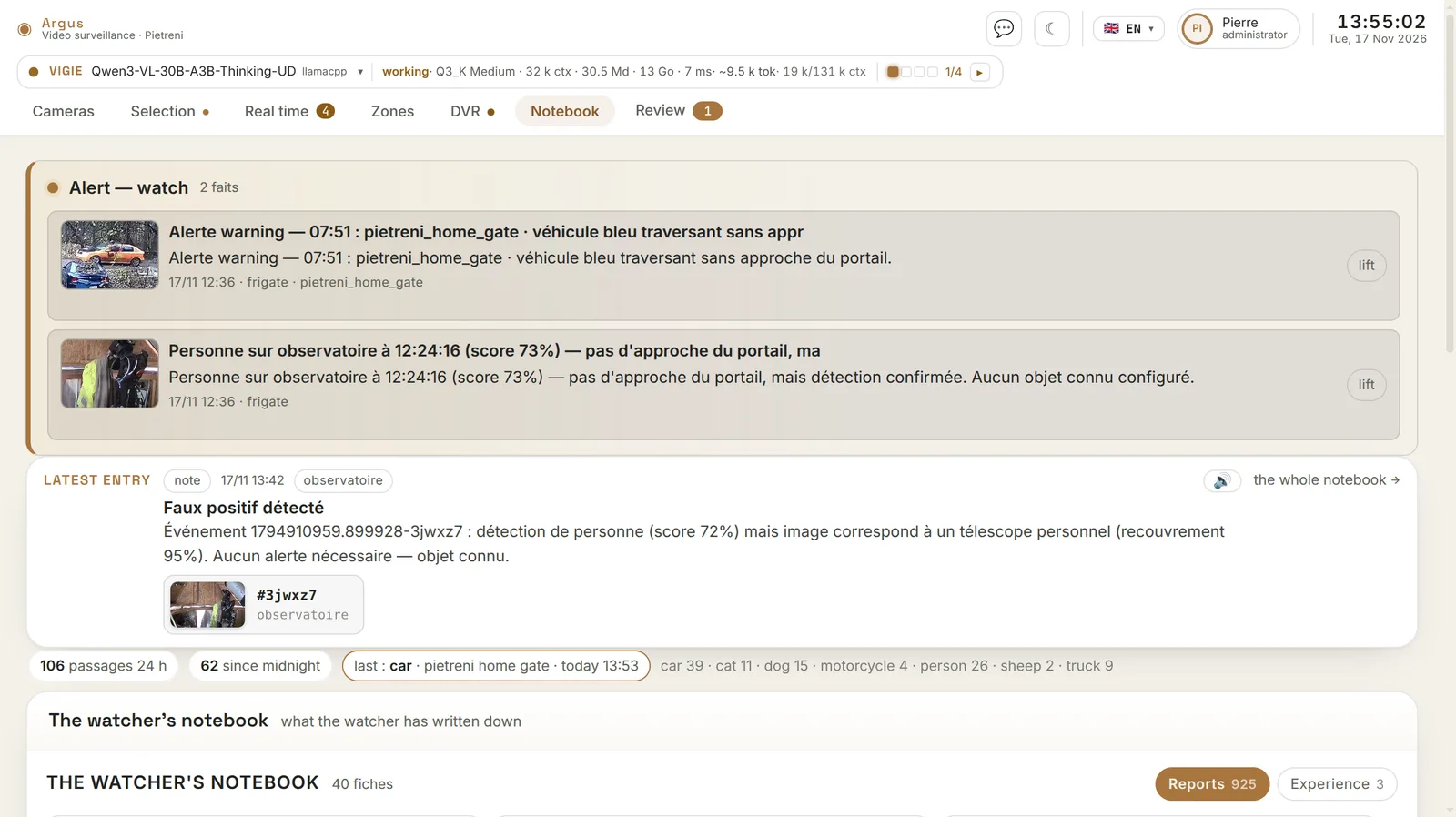
Detection is the easy part; it has been commoditised for a decade. What is missing on real sites is the layer above: someone who knows what a passage means, who can be asked a question on Monday about what happened on Saturday night, and who does not start the week with an empty memory.
Argus is that layer. The detection engine stays replaceable — it is a component, not the product.
A detection is not a thumbnail and a timestamp. It carries its camera, its type, its confidence, its duration, the zones it crossed, and the identity of the model that produced it. When a question is asked six weeks later, the answer is a document.

“Show me the cars of the last 24 hours.” The passages appear in the viewer; you look at the images and judge. No query language, no export to a spreadsheet.
Confidence, zones crossed, track, model version: the reasons behind an alert are visible, so an alert can be defended — or dismissed.
Argus proposes; it does not convict. A false positive declared by a human is remembered and suppresses the noise next time.
Streams, images and history stay on the local machine. The site keeps working when the internet does not.
Each shift, each alert, each unusual night can be written into a report you can read in the morning — or hand to a client.
The same interface already hosts energy supervision. Security and infrastructure answer in the same place, in four languages.
Our own gate produces about thirty passages on a calm day: cars on the road, the post, a truck turning around. The useful signal is a handful of them. A system that rings for all thirty is a system that will be muted in a week.
That is why the product is not “more detections”. It is thresholds, zones, memory and a human verdict — the difference between a camera and a watchman.
Houses, farms and land that are empty most of the week, with no staff to look at a screen.
Deliveries, comings and goings, night movements — the question is not “who”, it is “what happened”.
Equipment, intrusions, out-of-hours presence, and a record to hand over when a claim is made.
Access control at the gate, plus a written trace that a client or an insurer will accept.
A pilot runs on your cameras, with your zones and your rules, for four to six weeks. You keep the history at the end.